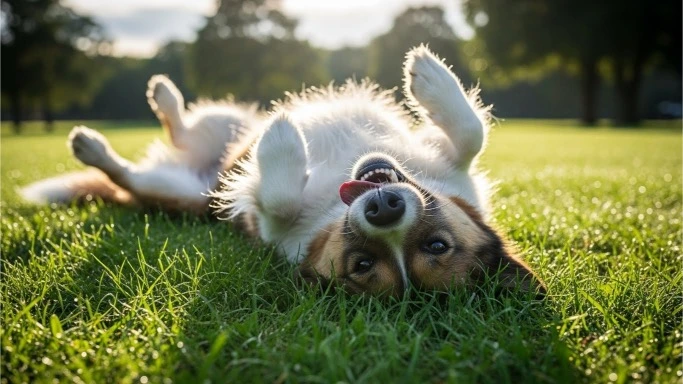
You’re out on a walk or relaxing in the yard, enjoying a peaceful moment — when suddenly your dog drops to the ground and starts rolling wildly in the grass. Back twisting. Legs kicking. Total joy.
You laugh… but you might also wonder:
Why does my dog roll in the grass?
Is it happiness?
Instinct?
A weird habit?
Or something you should worry about?
The good news is this: most of the time, grass-rolling is completely normal — and even healthy. But like many dog behaviors, the reason behind it matters.
In this guide, we’ll break down:
- The most common reasons dogs roll in the grass
- What your dog is communicating through this behavior
- When it’s harmless fun vs. when it signals a problem
- Whether you should stop it (and how)
- How instinct, scent, and emotion all play a role
No myths. No judgment. Just clear, honest answers from one dog lover to another.
The Short Answer: Rolling in the Grass Is Instinctive
At its core, grass-rolling is a natural dog behavior rooted in instinct, sensory pleasure, and communication.
Dogs don’t roll randomly.
They roll with purpose — even if it looks silly.
Sometimes it’s joy.
Sometimes it’s scent.
Sometimes it’s relief.
Let’s explore the real reasons behind it.
1. Your Dog Is Expressing Pure Happiness

This is the reason most people hope for — and often, it’s true.
Dogs roll in the grass when they feel:
- Happy
- Relaxed
- Playful
- Comfortable in their environment
You’ll often notice grass-rolling:
- During walks
- After playtime
- On sunny days
- In familiar, safe places
When your dog rolls with loose movements, relaxed ears, and playful energy, it’s usually a sign of pure joy.
Think of it as your dog saying, “Life feels good right now.”
2. It Feels Good on Their Body
Grass provides a unique physical sensation.
For dogs, rolling in grass can:
- Scratch hard-to-reach spots
- Massage their back
- Stretch muscles
- Relieve mild tension
Especially after exercise or a nap, grass-rolling can be your dog’s way of resetting their body.
This is common in:
- Active dogs
- Dogs with thick coats
- Dogs who enjoy sensory stimulation
If your dog looks relaxed afterward, the roll likely served its purpose.
3. Your Dog Is Following Ancient Instincts
Long before dogs slept on couches, their ancestors lived in the wild.
Rolling behaviors helped dogs:
- Mask their scent
- Blend into their environment
- Carry smells back to their pack
When your dog rolls in grass, they may be tapping into this ancient instinct.
Even though your dog doesn’t need to hide their scent anymore, the instinct remains.
To your dog, rolling can feel purposeful — even if it looks hilarious to us.
4. The Grass Smells Interesting (or Amazing)
Dogs experience the world through smell far more than sight.
Grass holds:
- Earthy scents
- Animal traces
- Pollen
- Fertilizer
- Moisture
- Natural oils
If your dog finds a particularly interesting patch, rolling helps them absorb that scent.
This is why dogs often roll:
- After sniffing intensely
- In the same spot repeatedly
- Where other animals passed
Your dog isn’t being weird — they’re exploring information.
5. Rolling Can Be a Way to Claim a Scent
Dogs communicate through scent.
By rolling, your dog may be:
- Mixing their scent with the environment
- Marking territory
- Bringing a scent back to you or their home
It’s subtle, instinctive communication — not dominance.
6. Your Dog Might Be Relieving Itchiness
Sometimes, grass-rolling is about comfort.
Dogs may roll to relieve:
- Mild itchiness
- Seasonal allergies
- Dry skin
- Minor irritation
If your dog rolls frequently and also:
- Scratches a lot
- Licks paws
- Shakes their body often
…it’s worth paying attention.
Occasional rolling is normal. Constant rolling may signal a skin issue.
7. Puppies Roll Because They’re Learning Their Bodies

Puppies roll in grass a lot — and that’s normal.
Puppies roll because:
- Everything feels new
- They’re exploring textures
- They’re learning coordination
- It’s fun
Most puppies roll less as they mature, though many keep the habit because they enjoy it.
8. Some Dogs Roll When They’re Overstimulated
Rolling can also be an emotional release.
If your dog rolls:
- During excitement
- After intense play
- When greeting you
- When overwhelmed
…it may be a way to release excess energy.
This type of rolling is usually quick and energetic.
9. Rolling Can Be Linked to Anxiety or Stress (Less Common)
In rare cases, rolling may be a coping behavior.
Signs it may be stress-related:
- Repetitive rolling
- Stiff movements
- Occurs during stressful events
- Paired with pacing or whining
If this happens often, it’s worth looking at emotional triggers.
Most grass-rolling, however, is not anxiety-based.
Is It Bad That My Dog Rolls in the Grass?
In most cases, no.
Grass-rolling is healthy when:
- It’s occasional
- Your dog appears relaxed
- There’s no skin irritation
- No obsessive behavior is present
It becomes a concern only if:
- Your dog rolls constantly
- Rolling replaces normal activities
- Skin problems appear
- Your dog seems uncomfortable
Context is everything.
Should I Stop My Dog from Rolling in the Grass?
That depends on where and how they’re rolling.
It’s Usually Fine to Allow It When:
- The grass is clean
- No chemicals were used
- Your dog isn’t hurting themselves
You May Want to Stop It When:
- Grass is treated with pesticides
- The area contains waste or dead animals
- Your dog has skin issues
- The behavior becomes obsessive
If you need to stop it, gently redirect — don’t scold.
How to Gently Redirect Grass Rolling
If rolling isn’t appropriate in the moment:
- Call your dog calmly
- Use a treat or toy to redirect
- Move to a new area
- Offer a walk or sniff time instead
Never punish rolling — it’s natural behavior.
Does Grass Rolling Mean My Dog Is Dirty or Unhappy?
No.
Rolling does not mean:
- Your dog dislikes being clean
- Your dog is unhappy
- Your dog is misbehaving
It simply means your dog is acting like a dog.
Common Questions Dog Parents Ask
Why does my dog roll in the grass after a bath?
Often because they want to replace the shampoo scent with something familiar.
Why does my dog roll in one specific spot?
That spot likely smells interesting or comforting.
Is rolling a sign of dominance?
No. This is a myth.
Why does my dog roll then look at me?
They’re checking your reaction or inviting play.
Is it normal for dogs to roll in the grass?
Yes. It’s a very common and natural behavior.
Does grass rolling mean my dog is itchy?
Sometimes, but not always. Look for other signs.
Should I let my dog roll during walks?
Yes, if the area is safe and clean.
Can rolling ever be a health concern?
Only if it’s excessive or paired with skin issues.
For more information, check out this source.
You will also like to read Dog Body Language.
The bottom line
When your dog rolls in the grass, they’re not being strange or stubborn.
They’re:
- Enjoying the moment
- Following instinct
- Exploring scent
- Releasing energy
- Feeling comfortable in their world
Most of the time, grass-rolling is a sign your dog feels safe, happy, and free.
So the next time your dog drops into the grass and starts rolling with pure joy, take a moment to smile — you’re witnessing one of the simplest pleasures in a dog’s life.