
How to Stop Your Dog From Barking
If your dog barks at every leaf, doorbell, squirrel, or shadow… you’re not alone. Barking is one of the most common challenges dog parents deal with — and one of the most misunderstood behaviors in our furry companions.
Here’s the truth many never hear:
Dogs don’t bark to annoy us — they bark to communicate.
And when we respond with yelling, punishment, or frustration, we don’t fix the root issue — we simply confuse and stress our dogs, which can make barking worse.
Today, we’re going beyond quick fixes. I’ll show you gentle, science-backed methods to stop excessive barking the kind, compassionate way — while building trust and a calmer home. No shock collars. No yelling. Just understanding, training, and teamwork.
Let’s help your dog find their quiet confidence — and your home, its peaceful soundtrack again.
Why Dogs Bark — Understanding the Real Reason First
Before we teach quiet behavior, we need to know why the barking happens. Every bark has an emotion behind it — fear, excitement, boredom, frustration, alertness. When we identify the cause, we can teach the right solution.
Common Reasons Dogs Bark
- Alert barking — “Someone’s here! I must protect!”
- Excitement barking — playtime, seeing another dog, guests arriving
- Attention-seeking — “Look at me! Play with me!”
- Frustration barking — blocked from something they want (like the window)
- Anxiety barking — separation stress, fear, insecurity
- Boredom — lack of stimulation, exercise, or enrichment
According to a training guide by the American Kennel Club, understanding the source of barking behavior dramatically increases training success .
Internal Tip
Don’t Yell — Here’s Why Positive Reinforcement Works Better
If your dog barks when frustrated or playful, help them channel energy differently. Many exercises double as frustration-reducing enrichment!
It feels natural to yell when barking gets overwhelming — but to dogs, yelling often sounds like you’re barking too. That means more chaos, confusion, and stress.
Punishment Causes:
-More anxiety
-Loss of trust
-Worse barking over time
Positive Training Benefits:
-Improves listening skills
-Builds confidence and trust
-Reduces anxiety-based barking
-Strengthens the human-dog bond
Research from VCA Animal Hospitals confirms that positive training methods support calmer behavior and reduce stress-driven reactions .
Pro Tip
Instead of “NO BARKING!” try these commands:
- “Thank you” — acknowledges alert bark, then signals quiet
- “Quiet” — paired with reward when silence occurs
- “Watch me” — redirects focus to you
Reward quiet moments — even short ones — with praise, treats, or affection. You’re rewarding peace, not noise.
Teach the “Quiet” Command the Kind Way (Step-by-Step Guide)
Teaching “Quiet” isn’t about silencing your dog — it’s about showing them calm gets rewards and noise gets… absolutely nothing special.
Training Steps
How to Stop Your Dog From Barking

How to Stop Your Dog From Barking
- Wait for a bark
(Yes — we start after the bark. Your dog’s like, “Finally, a training I understand!”) - Say “Quiet” once in a calm voice
No yelling. Think “yoga instructor energy,” not “traffic officer.” - Reward the silence
The moment your dog pauses barking — treat and praise. - Repeat in short sessions
Five minutes at a time is perfect — dogs appreciate snack-sized training.
Pro Tip
Be generous at first. If your dog stops barking for one second, reward.
Later you’ll stretch the time before reward — like slow-motion quiet champions.
Why It Works
Dogs learn more from rewarding calm than punishing noise. You’re reinforcing the behavior you want, not the one you don’t.
Want more puppy behavior shaping? Check out our internal guide: How to Train a Puppy Not to Bite — many of those focus-shaping tricks help with barking too.
Stop Barking Before It Starts — Remove Triggers
Sometimes barking isn’t about manners — it’s about the environment setting your dog up to fail.
Let’s talk trigger control
Visual Triggers
Dogs bark at what they see:
- Squirrels
- Delivery drivers
- Walking neighbors
- That one suspicious butterfly
Fix:
Use frosted window film, curtains, or “look at this instead” training.
Sound Triggers
Doorbells, knocking, car doors closing…
Fix:
- Play “doorbell sounds” on low volume while rewarding calm
- Practice calm greetings (“sit, treat, greet”)
- Use white-noise fan when away
A behavior guide from the American Kennel Club notes that desensitization training reduces noise reactivity over time — especially when paired with positive reinforcement.
House Rule
If your dog feels like an alarm system, they’ll act like one.
We’re teaching companion mode, not security guard mode
Tire the Brain, Calm the Bark — Mental Exercise Matters
A tired dog is quiet.
But here’s a secret: mental exercise works even better than physical exercise for barking control.
Mental Stimulation Ideas
| Activity | Why It Helps |
| Puzzle toys | Problem-solving reduces vocal frustration |
| Scent work games | Sniffing lowers stress and barking urges |
| Frozen treat toys | Keeps mouth busy, not barky |
| Training drills 5–10 mins/day | Builds focus & calm impulse control |
Puzzle toys have been shown to reduce boredom-barking behaviors, according to many veterinary behaviorists.
If your dog barks at birds, teach them to “hunt treats” instead — much more productive than arguing with sparrows.
Trainer Tip
Play “Find It!” by tossing tiny treats around the house.
Search mode = bark reducer!
Redirection Magic — Give Your Dog a Better Job Than Barking
How to Stop Your Dog From Barking
How to Stop Your Dog From Barking
Sometimes barking isn’t misbehavior — it’s a job your dog assigned themselves:
“Head of Home Security,” self-appointed and very dedicated.
Instead of saying “Stop barking,” try:
“Here’s your real job.”
Redirection Ideas
| Trigger | New Job | Example |
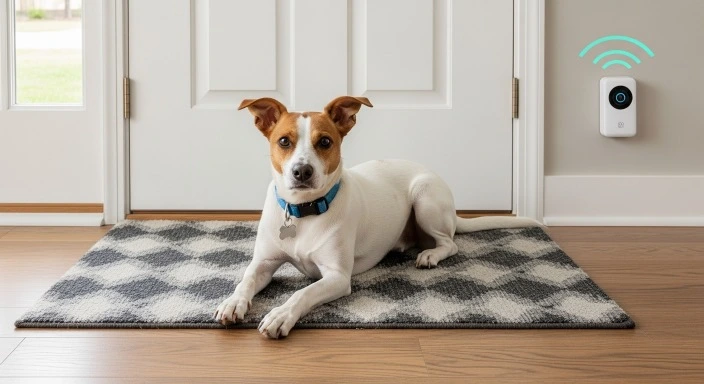
| Doorbell | Go to bed/mat | “Go place!” → treat → greet calmly |
| Other dogs | “Look at me” focus | High-value treat, eye contact |
| Boredom | Sniff game / puzzle | Scatter food or toy time |
| Separation stress | Calming chew + safe space | Peanut-butter lick mat, cozy crate |
Dogs can’t bark and sniff, chew, or focus at the same time.
Give the mouth and brain a job = barking turns off like a light switch.
A helpful guide from RSPCA notes that redirecting to an incompatible behavior (like “settle” or “place”) can drastically reduce barking linked to stress and arousal.
Calm Greetings — Stop Doorway Chaos
Does your dog act like you just returned from war every time someone opens the door?
Here’s your new greeting ritual — short, sweet, life-changing:
Calm-Greeting Routine
- Guest rings doorbell
- You say “Place” — dog goes to mat/spot
- Quiet moment = treat
- Guest enters calmly
- Then dog may say hello
No yelling. No pushing the dog back.
We teach patience > excitement.
Pro Behavior Tip:
Start with easy “fake visits” —
- Door knock sound on your phone
- Household member stepping out & back in
- Reward calm, ignore chaos
Calm becomes their habit — and the barking melts away.
When Barking Means Anxiety, Not Attitude
Some dogs bark not because they’re “bad,” but because they’re worried, lonely, or overstimulated.
Signs barking = stress:
- Pacing
- Whining
- Destructive chewing
- Drooling when alone
- “Velcro dog” behavior
If this sounds familiar, your pup may need:
– Predictable routine
– Comfort training
– Desensitization to leaving cues
– Soothing chews or white noise
– Patience (lots of it)
According to The Humane Society, separation-anxiety barking improves with gradual alone-time training — never punishment or forced isolation.
For severe cases:
A certified trainer or vet behaviorist can help design a structured plan.
Final Thought: Quiet Confidence, Not Quiet Fear
You didn’t choose a stuffed animal.
You chose a living, emotional, loving companion — who talks in woofs instead of words.
Barking is communication, not rebellion.
When we respond with understanding, structure, and patience, we teach our dogs:
“You’re safe. You don’t have to be on duty all the time.
I’ve got this — and I’ve got you.”
Quiet isn’t the goal.
Calm is.
Confidence is.
Connection is.
And good news? You’re already building it.
How to Stop Your Dog From Barking
Authority Sources
- AKC: Understanding & Managing Dog Barking
- RSPCA: Dog Barking — Causes & Solutions
- Humane Society: Separation Anxiety in Dogs
How to Stop Your Dog From Barking

How to Stop Your Dog From Barking
How to Stop Your Dog From Barking
How to Stop Your Dog From Barking
How to Stop Your Dog From Barking
How to Stop Your Dog From Barking